Quick answer Basement mould removal starts with the moisture. Health Canada says mould can begin to grow within 48 hours of a wet spot forming.[1] Small areas, meaning three or fewer patches totalling less than one square metre, can generally be cleaned with dish soap, water and protective equipment, but mould returns unless the moisture source is fixed.[2]
On this page: Why basements grow mould · How to tell it is mould · Health effects · How big is the problem? · Basement mould removal: how to get rid of mould in a basement · When to hire a professional · Preventing mould in a basement · What it can cost · Frequently asked questions · Sources
Why basements grow mould
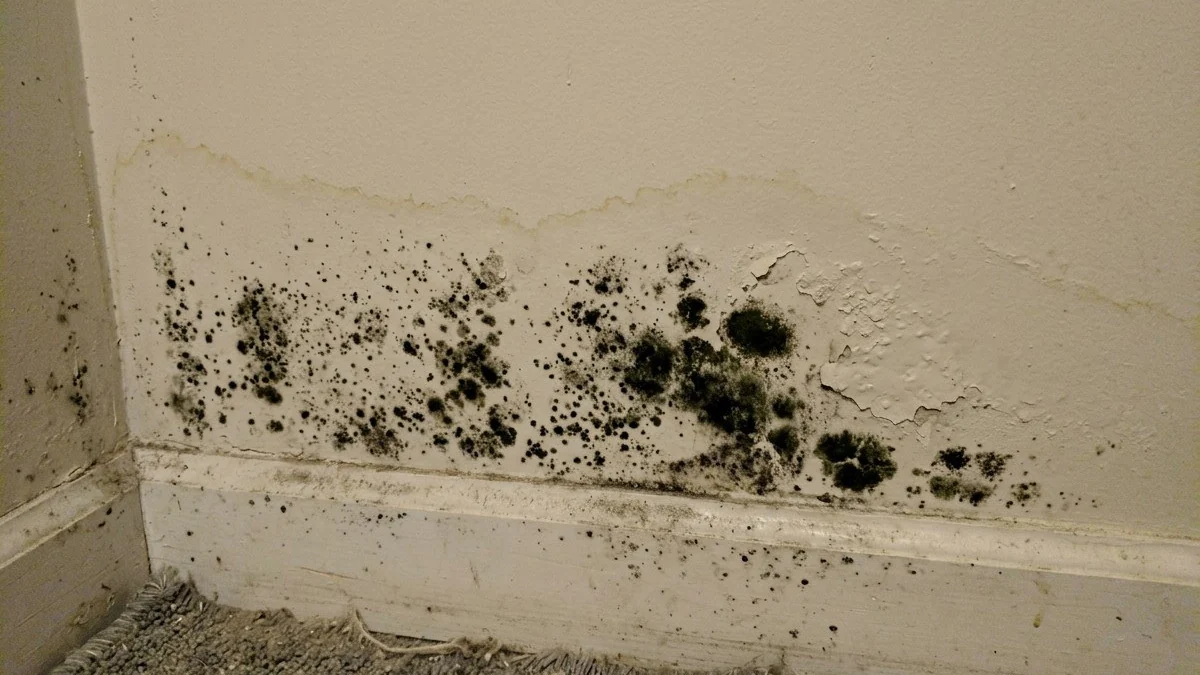
Health Canada says mould will typically grow indoors if moisture is present. Its list of ways moisture builds up includes infiltration of water through cracks or leaks in the foundation, floor or walls, plumbing leaks, condensation on cold surfaces, flooding from weather and inadequate ventilation.[1] CMHC adds basement-specific causes, among them an earth floor, grading that slopes toward the house, a high water table, a sump pump that is not operating properly, a humidifier that is poorly set and an unvented clothes dryer.[3]
The U.S. Environmental Protection Agency puts the principle simply: the key to mould control is moisture control.[4] Dealing with the mould without dealing with the water is a temporary fix. If water is entering the basement, read why a basement leaks.
How to tell it is mould
Not all mould is obvious. Health Canada says to look for stains or discolouration on floors, walls, window panes, fabrics and carpets, and to notice a musty, earthy odour.
Mould can also grow behind walls or above ceiling tiles.[2] CMHC lists mould on stored items, in the corners of outside walls and on overhead joists behind insulation among basement signs.[3]
A smell without a visible patch is common. Health Canada says that if strong musty odours are detected with no clear signs of water damage or mould, you may consider consulting a professional about hidden mould in walls and ceiling or floor cavities.[1] See our guide to a musty smell in the basement.
Health Canada does not recommend testing the air for mould in most situations. It says an air test does not provide information that can predict health effects and often offers little information on the cause of the damage. Finding and fixing the moisture is the goal.[1]
Health effects
Health Canada says people living in homes with mould and damp conditions are more likely to have eye, nose and throat irritation, coughing and phlegm build-up, wheezing and shortness of breath, and worsening of asthma symptoms. Infants, children, seniors, pregnant people and people with respiratory conditions such as asthma may be at greater risk.[1] If you think your health problems might be related to mould, talk to your health care professional.[2]
How big is the problem?
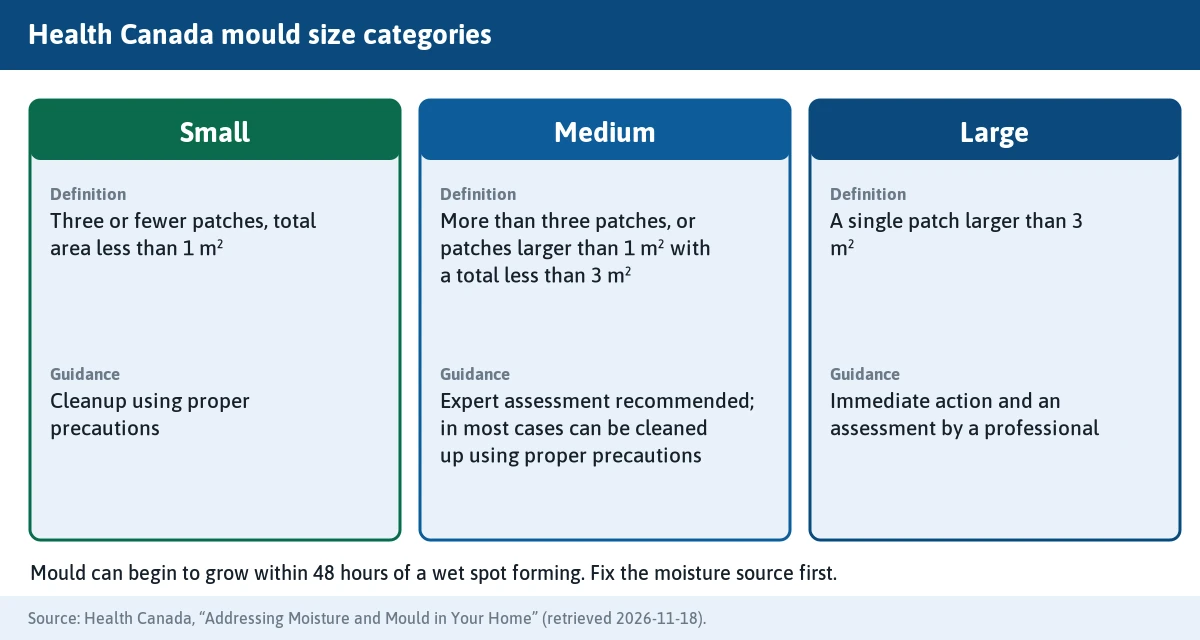
Health Canada classifies mould by the area affected:[1]
| Size | Definition | Health Canada’s guidance |
|---|---|---|
| Small | Three or fewer patches, total area less than 1 m² | Cleanup using proper precautions |
| Medium | More than three patches, or patches larger than 1 m² with a total less than 3 m² | Expert assessment recommended; in most cases can be cleaned up using proper precautions |
| Large | A single patch larger than 3 m² | Immediate action and an assessment by a professional |
For reference, the EPA suggests that homeowners can generally handle an area of about 10 square feet or less themselves.[4]
Basement mould removal: how to get rid of mould in a basement
Health Canada’s steps for a small to moderate area:[2]
- Wear safety glasses or goggles, a disposable N95 respirator and disposable household gloves.
- Consider isolating the area by taping plastic sheeting to the walls and ceiling.
- Vacuum with a HEPA vacuum cleaner before and after cleaning.
- Clean the mould with water and dish detergent. There is no need for bleach. When cleaning drywall, use a damp cloth so you do not make the drywall wet.
- Keep susceptible people out of the room or near the area.
Health Canada also advises throwing away carpets, sofas, cushions, mattresses and similar items that have been wet or stored in damp conditions, noting that it is not possible to properly clean a mouldy mattress.[1] The EPA says not to paint or caulk over mouldy surfaces, and that porous materials such as ceiling tiles and carpet may have to be thrown away.[4]
Fix the cause before you clean
Health Canada says the underlying water or moisture problem should be fixed first so mould does not return. If water is coming through the foundation, the building envelope must be repaired.[1] Depending on the source, that could mean the exterior waterproofing or interior waterproofing described in our guides, a dehumidifier for humidity, or repairs to plumbing and grading.
When to hire a professional
Health Canada lists situations that call for a qualified professional:[1]
- a single patch larger than three square metres
- mould that returns after cleaning, which suggests the moisture source has not been addressed
- flood or leak water that was contaminated with sewage or chemical or biological pollutants
- previous efforts have not solved the problem, including ongoing health symptoms
- suspected hidden mould inside walls or above ceilings
- flooding that has penetrated wall cavities or ceiling or floor cavities
Health Canada’s advice on choosing one includes getting proposals the way you would for home renovations, expecting a preliminary site visit and a written scope, and asking whether the company has relevant certification and liability insurance covering mould removal. For extensive cleanup involving structural elements it recommends hiring a separate company for a post-remediation “clearance” study.[1] Our guide to how to choose a waterproofing contractor covers the moisture side, and the company directory lists local companies.
Preventing mould in a basement
Wall sheet products used inside are covered in our dimple membrane guide. Health Canada’s prevention measures include:[2][1]
- keeping relative humidity between 30 per cent and 50 per cent, using a dehumidifier as needed, and a hygrometer to measure it
- running kitchen and bathroom fans and venting dryers and fans outdoors
- repairing leaks quickly and cleaning up right after a flood
- throwing out cardboard clutter, storing items in plastic bins with lids and never placing cardboard boxes directly on the basement floor
- considering removing carpets from the basement floor
- running a dehumidifier in damp areas such as basements, especially if humidity exceeds 50 per cent
CMHC adds that you should dehumidify the basement during warm months with windows closed, and insulate walls only if the moisture problem is solved.[3] If the problem is condensation, see condensation on basement walls.
For wet floors, see wet basement floor. If a crawl space is involved, see crawl space mould.
What it can cost
We have not found a government or research source that publishes a cost range for professional mould remediation, so we do not give one. For the moisture side, the Intact Centre lists a standalone dehumidifier at $175 to $400 and a bathroom exhaust fan at $500 to $1,200.[5] For waterproofing prices, see basement waterproofing cost and the wider basement waterproofing guide.
Terms used in quotes are explained in hydrostatic pressure, efflorescence and dampproofing. Our permits guide covers waterproofing work that may need approval.
Frequently asked questions
Is black mould more dangerous than other mould?
Health Canada says the level of risk depends on the extent of mould growth, regardless of the species, how long it has been present, and how susceptible the people exposed are. It recommends cleaning up any visible mould regardless of type.[1]
Do I need to test my basement for mould?
In most cases, no. Health Canada says there is usually no need to measure the concentration of mould in indoor air or identify the species. You need to find and fix the moisture and the mould.[2]
Can I use bleach?
Health Canada says there is no need to use bleach. Clean with water and dish detergent.[2]
How quickly does mould grow?
Health Canada says mould will begin to grow in an area with excessive moisture within 48 hours, and the EPA advises drying water-damaged areas within 24 to 48 hours.[1][4]
Will waterproofing remove mould?
No. Waterproofing can remove a moisture source, but existing mould still has to be cleaned or removed. Health Canada says to fix the moisture first and then remove the mould.[1]
When should I call a professional?
For a patch larger than three square metres, mould that keeps coming back, sewage-contaminated water, suspected hidden mould or flooding that has reached wall cavities.[1]
I rent. Who is responsible?
Health Canada says tenants should speak to their landlord and refers readers to their provincial or territorial government for landlord and tenant information.[2]
Find a pro. Looking for companies near you? Search the Waterproofing Service directory by service and city. Find waterproofing pros
Sources
- Health Canada (Canada.ca), published January 2023. “Guide to addressing moisture and mould indoors.” https://www.canada.ca/en/health-canada/services/publications/healthy-living/addressing-moisture-mould-your-home.html (retrieved 2026-11-18).
- Health Canada (Canada.ca). “Mould.” https://www.canada.ca/en/health-canada/services/air-quality/indoor-air-contaminants/reduce-humidity-moisture-mould.html (retrieved 2026-11-18).
- Canada Mortgage and Housing Corporation (CMHC). “Moisture and Air: A Guide for Understanding and Fixing Interior Moisture Problems in Housing.” https://assets.cmhc-schl.gc.ca/sf/project/archive/publications/61033_w_05_08_2015.pdf (retrieved 2026-11-18).
- U.S. Environmental Protection Agency. “A Brief Guide to Mold, Moisture and Your Home.” https://www.epa.gov/mold/brief-guide-mold-moisture-and-your-home (retrieved 2026-11-18).
- Intact Centre on Climate Adaptation, University of Waterloo (information verified and updated by AET Group, 2024). “Estimated Cost Ranges for Completing Residential Flood Protection Projects.” https://intactcentreclimateadaptation.ca/wp-content/uploads/2024/10/Cost-Range-for-Flood-Risk-Reduction-Projects_final_2024.pdf (retrieved 2026-11-18).