Quick answer How to choose a basement waterproofing contractor: get written estimates from at least three firms that inspected the basement, check references and the Consumer Beware List, confirm workplace safety insurance, and sign a written contract. In Ontario the final price cannot exceed the contract estimate by more than 10 per cent without a signed change.[1]
On this page: What should you do before you call anyone? · How to choose a basement waterproofing contractor: seven checks before you sign · What a WSIB clearance does and does not tell you · Questions to ask a waterproofing contractor about the work · How to compare three estimates · What should the contract include? · What are the warning signs? · If subsidies are involved · If mould is part of the job · Finding companies · Frequently asked questions · Sources
What should you do before you call anyone?
Ontario’s guidance starts with homework. Make a list of exactly what you want done, remembering that changing plans mid-project costs extra, and set a clear budget.[1] For waterproofing, add a third item: learn what is causing the water.
CMHC lists cracks, a high water table, poor grading, a failed sump pump and blocked footing drains among the causes of basement moisture, and the fix for each differs.[2] Our guide to why a basement leaks can help you describe the problem when you phone. If you cannot say what you think the cause is, say when it happens: after rain, after snow melt, or all year.
Canada.ca also advises checking with your local government about permits or inspections before any drain work, and consulting a professional to confirm that the work suits your home.[3] Put a permit question in every estimate request: who applies, who pays and who books the inspection.
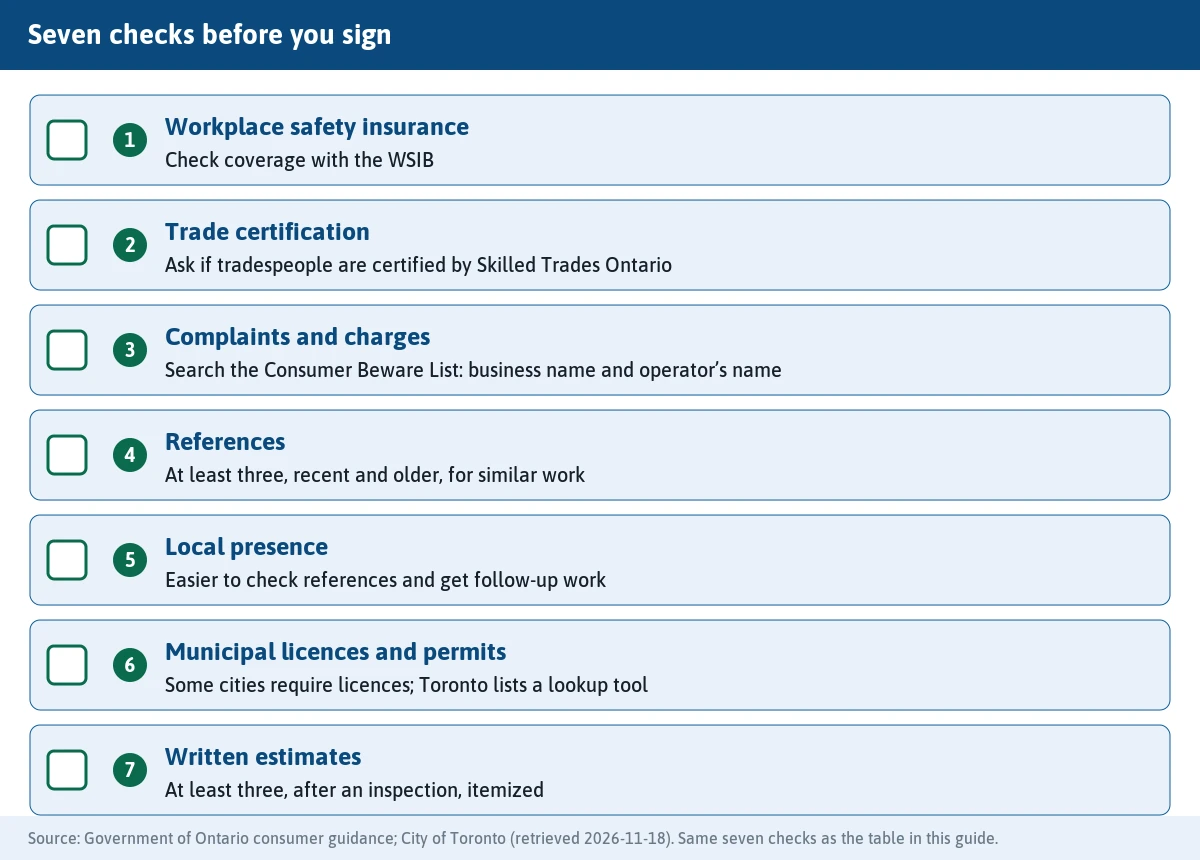
How to choose a basement waterproofing contractor: seven checks before you sign
| # | Check | What the public sources say |
|---|---|---|
| 1 | Workplace safety insurance | Workers and self-employed operators in the construction industry must have workplace safety and insurance coverage, with some exceptions; contact the Workplace Safety and Insurance Board (WSIB) to check[1] |
| 2 | Trade certification | Ask if the tradespeople hired have their certification from Skilled Trades Ontario[1] |
| 3 | Complaints and charges | Search the Consumer Beware List and the postings of charges and convictions under the Consumer Protection Act. A single operator may run several businesses or change a business name, so search for both the business name and the operator’s name[1] |
| 4 | References | Get at least three references and check them, including some from the recent past and some from further back, from people who had similar work[1] |
| 5 | Local presence | A local company may make it easier to check references, enforce a warranty or have follow-up work done[1] |
| 6 | Municipal licences and permits | Some cities require licences. Toronto requires that contractors on subsidy-eligible work hold a valid City of Toronto business licence, and offers a lookup tool[4] |
| 7 | Written estimates | At least three, never over the phone or without inspection, with a description of the work and an itemized list of products, services and prices[1] |
Ontario also suggests checking with the Better Business Bureau, chambers of commerce and your city for any information they have on the contractor, and consider dealing with a local company.[1]
An example of what a city checks
When the City of Hamilton built its list of pre-qualified contractors for its Protective Plumbing Program, it required at least one licensed master plumber or master drain layer with five years’ experience, proof of operating for at least three consecutive years, and a trade licence under its by-law. It also asked each contractor to confirm minimum commercial general liability insurance of $2 million and either WSIB coverage or an exemption.[5]
That is a standard for plumbing work under one municipal program, not a rule for all waterproofing. It shows the kinds of questions worth asking any contractor.
What a WSIB clearance does and does not tell you
The WSIB issues a clearance number to show that a business is registered and up to date with its premiums and reporting.[6] A clearance is valid for up to 90 days, so a valid one has to be in place for the full length of a job.[6] You can check a contractor’s status using the WSIB’s online service, which lets you search by business name, telephone, address or city.[6]
Here is the catch for homeowners. WSIB’s policy says clearances are not required when a householder directly hires a contractor for exempt home renovation work only.[7] Where a clearance is required, starting construction work without one is an offence for both the principal and the contractor.[7]
That is why the Government of Ontario’s advice is to confirm coverage rather than to demand a certificate.[1] If the contractor hires a subcontractor, the contractor becomes the principal for that work and must obtain the subcontractor’s clearance before the work begins.[6]
So ask for the contractor’s WSIB account or clearance number, check it online, and write the answer into your notes with the date. If a contractor says they do not need coverage, ask why, and check the WSIB’s policy for your type of job rather than taking the answer on trust.
Questions to ask a waterproofing contractor about the work
Ask these in writing and compare the answers. The glossary entries on hydrostatic pressure and efflorescence explain terms that may come up.
- What is causing the water, and how did you find out? A contractor who quotes without inspecting or diagnosing is guessing. Ontario advises never accepting an estimate without the contractor inspecting the area.[1]
- Which method, and why? Compare exterior waterproofing and interior waterproofing using our interior versus exterior guide.
- Which products, to which standard? The Ontario Building Code names standards for exterior dampproofing and waterproofing materials, and requires installation to the manufacturer’s instructions.[8][9] Ask for the spec sheet.
- Where will the water go? The code requires foundation drains to discharge to a sewer, drainage ditch or dry well.[10] Toronto advises hiring a City-licensed plumber for work on weeping tile connections, backwater valves and sump pumps.[11]
- Which permits does this need, and who pulls them? Ontario says it is your responsibility to get building permits and meet legal requirements, and that if you want the contractor to get them, it should be spelled out in the contract.[1] Toronto requires a building permit for a backwater valve.[4] Our permits guide explains how to check.
- What happens to landscaping, floors and finishes? The Intact Centre’s price list treats restoration and finishes as separate from the dampproofing item, so ask.[12]
- What does the warranty cover, and who honours it? Ontario advises checking warranties carefully, but notes the contractor’s reputation and time in business are more important than a warranty.[1]
How to compare three estimates
Put the quotes side by side. This blank table is a way to see where they differ.
| Item | Contractor A | Contractor B | Contractor C |
|---|---|---|---|
| Cause identified, and how | |||
| Method (exterior, interior, drainage, pump, crack repair) | |||
| Length of wall treated; depth or floor area opened | |||
| Products and standards | |||
| Drainage, sump pit, pump, battery backup, alarm | |||
| Where the water discharges | |||
| Permits and inspections | |||
| Restoration and cleanup | |||
| Warranty terms | |||
| Start and finish dates | |||
| Total, deposit and payment schedule |
If one quote is far lower, check what it leaves out. The Intact Centre’s list separates dampproofing from dampproofing with drainage and prices crack repair by depth and area, which is why scope matters as much as price.[12] For published ranges, see basement waterproofing cost.
What should the contract include?
Under Ontario law any home renovation contract worth more than $50 must be in writing. Ontario says your contract should include:[1]
- the contractor’s name, address and contact information
- a thorough description of the project, including the work to be done and the materials to be used
- a clear description of any warranties
- the total cost and terms of payment
- a work schedule with start and completion dates
- a payment schedule, including the deposit amount
- who is responsible for cleanup
- all sub-trades and who pays for them
Three further protections apply:
- The 10 per cent rule. If the estimate is part of the contract, the final price cannot be more than 10 per cent over the estimate unless you agree to new work or a new price and sign a change.[1]
- Deposits. Keep down payments to a minimum; Ontario recommends no more than 10 per cent, and never paying the full amount before the work is done.[1]
- Cooling-off period. If you sign a contract worth $50 or more in your home, you have 10 calendar days to cancel for any reason without cancellation fees. If work started during that time, you owe reasonable compensation for work and materials already provided.[1]
Ontario also advises avoiding cash deals, and if a contractor offers financing, it may be wiser to arrange your own.[1] If you are doing major renovation work it is best to have a lawyer go over the contract.[1]
What are the warning signs?
One technical check helps you test a quote. For new construction, the Ontario Building Code asks for drain pipe at least 100 mm in diameter, covered on top and sides by at least 150 mm of clean crushed stone.[13][14] It is not a repair specification, but a contractor who proposes new drain pipe should be able to tell you the pipe size, the stone and where the water will go.
Ontario describes two common scams that show up in home repair:[1]
- The door-to-door game. A salesperson offers a “good deal” because they are in the neighbourhood with material and equipment and the contract must be signed right away, or offers a free “inspection” and then tells you immediate, expensive repair is needed.
- The disappearing contractor. A contractor asks for a large down payment “to pay for materials” and then does not finish, or does not start.
Also be cautious when a quote offers a single solution to every problem, or when a contractor does not ask questions. Ontario notes good contractors ask a lot of questions so they can plan the project.[1]
If subsidies are involved
Municipal programs set their own contractor rules. In Toronto, your contractor and any subcontractors must have a valid City business licence at the time of the work, and you need original electronic invoices from each.[4] In Hamilton, owners who choose a contractor outside the City’s pre-qualified list are eligible for a maximum of $500 for a backwater valve.[15]
Ontario also says it is your responsibility to confirm that you qualify for any rebate a contractor mentions.[1] For local context see our pages on Toronto and Hamilton.
If mould is part of the job
Health Canada’s advice on hiring a mould professional is to solicit proposals the way you would for home renovations, expect a preliminary site visit and a written scope, ask whether the company has appropriate certification and liability insurance covering mould removal, and, for extensive structural cleanup, hire a separate company for a post-remediation clearance study.[16] See basement mould.
Finding companies
Our company directory lists companies by place. Listings are not a substitute for the checks above. Start with basement waterproofing if you are still deciding which kind of work you need, and see Ontario for provincial context.
Frequently asked questions
How many quotes should I get?
At least three written estimates, according to the Government of Ontario.[1]
Should I accept a quote over the phone?
No. Ontario advises never to accept an estimate over the phone or without the contractor inspecting the area.[1]
How much deposit is reasonable?
Ontario recommends no more than 10 per cent, and never paying the full amount before the work is done.[1]
What if the contractor wants more than the estimate?
If the written estimate is part of the contract, the final price for goods and services cannot be more than 10 per cent over the estimate unless you agreed to new work or a new price and signed a change.[1]
Can I cancel after signing?
If you signed at home and the contract is worth $50 or more, you can cancel for any reason within 10 calendar days without cancellation fees.[1]
How do I check a contractor’s complaints history?
Search the Consumer Beware List and the charges and convictions postings, using both the business and the operator’s name, as Ontario advises.[1]
Does a warranty matter?
Check it carefully, but Ontario says the contractor’s reputation and length of time in business are more important than a warranty.[1]
Do I need a licence or certification?
Requirements vary by trade and municipality. Ontario advises asking if tradespeople have certification from Skilled Trades Ontario, and some cities license contractors.[1][4]
Find a pro. Looking for companies near you? Search the Waterproofing Service directory by service and city. Find waterproofing pros
Sources
- Government of Ontario. “Your rights when starting home renovations or repairs.” https://www.ontario.ca/page/your-rights-when-starting-home-renovations-or-repairs (retrieved 2026-11-18).
- Canada Mortgage and Housing Corporation (CMHC). “Moisture and Air: A Guide for Understanding and Fixing Interior Moisture Problems in Housing.” https://assets.cmhc-schl.gc.ca/sf/project/archive/publications/61033_w_05_08_2015.pdf (retrieved 2026-11-18).
- Government of Canada (Canada.ca, flood risk guidance). “French drains, trench drains and weeping tiles.” https://www.canada.ca/en/services/policing/emergencies/preparedness/get-prepared/hazards-emergencies/floods/flood-risk/prevent-flood-damage/french-drains-trench-drains-and-weeping-tiles.html (retrieved 2026-11-18).
- City of Toronto. “Basement Flooding Protection Subsidy Program.” https://www.toronto.ca/services-payments/water-environment/managing-rain-melted-snow/basement-flooding/basement-flooding-protection-subsidy-program/ (retrieved 2026-11-18).
- City of Hamilton. “Protective Plumbing Program (S3P) Assessment Form, 2026.” https://www.hamilton.ca/sites/default/files/2026-01/basementflooding-protective-plumbing-program-assessment-form-rev15-jan2026.pdf (retrieved 2026-11-18).
- Workplace Safety and Insurance Board (WSIB). “Questions and answers: Clearances.” https://www.wsib.ca/en/clearancefaqs (retrieved 2026-11-18).
- Workplace Safety and Insurance Board (WSIB). “Clearance Certificate in Construction (operational policy).” https://www.wsib.ca/en/operational-policy-manual/clearance-certificate-construction (retrieved 2026-11-18).
- Ontario Building Code text as reproduced by CodeIndex. “Ontario Building Code 2024 (O. Reg. 163/24), Article 9.13.2.2 Dampproofing Materials.” https://codeindex.ca/article/9.13.2.2 (retrieved 2026-11-18).
- Ontario Building Code text as reproduced by CodeIndex. “Ontario Building Code 2024 (O. Reg. 163/24), Article 9.13.3.4 Application of Waterproofing Membranes.” https://codeindex.ca/article/9.13.3.4 (retrieved 2026-11-18).
- Ontario Building Code text as reproduced by CodeIndex. “Ontario Building Code 2024 (O. Reg. 163/24), Article 9.14.5.1 Drainage Disposal.” https://codeindex.ca/article/9.14.5.1 (retrieved 2026-11-18).
- City of Toronto (page dated April 17, 2026). “How to Prevent Basement Flooding.” https://www.toronto.ca/services-payments/water-environment/managing-rain-melted-snow/basement-flooding/how-to-prevent-basement-flooding/ (retrieved 2026-11-18).
- Intact Centre on Climate Adaptation, University of Waterloo (information verified and updated by AET Group, 2024). “Estimated Cost Ranges for Completing Residential Flood Protection Projects.” https://intactcentreclimateadaptation.ca/wp-content/uploads/2024/10/Cost-Range-for-Flood-Risk-Reduction-Projects_final_2024.pdf (retrieved 2026-11-18).
- Ontario Building Code text as reproduced by CodeIndex. “Ontario Building Code 2024 (O. Reg. 163/24), Article 9.14.3.2 Minimum Size (drain tile).” https://codeindex.ca/article/9.14.3.2 (retrieved 2026-11-18).
- Ontario Building Code text as reproduced by CodeIndex. “Ontario Building Code 2024 (O. Reg. 163/24), Article 9.14.3.3 Installation (drain tile).” https://codeindex.ca/article/9.14.3.3 (retrieved 2026-11-18).
- City of Hamilton (page dated September 3, 2026). “Protective Plumbing Program.” https://www.hamilton.ca/home-neighbourhood/home-property/basement-flooding/protective-plumbing-program (retrieved 2026-11-18).
- Health Canada (Canada.ca), published January 2023. “Guide to addressing moisture and mould indoors.” https://www.canada.ca/en/health-canada/services/publications/healthy-living/addressing-moisture-mould-your-home.html (retrieved 2026-11-18).