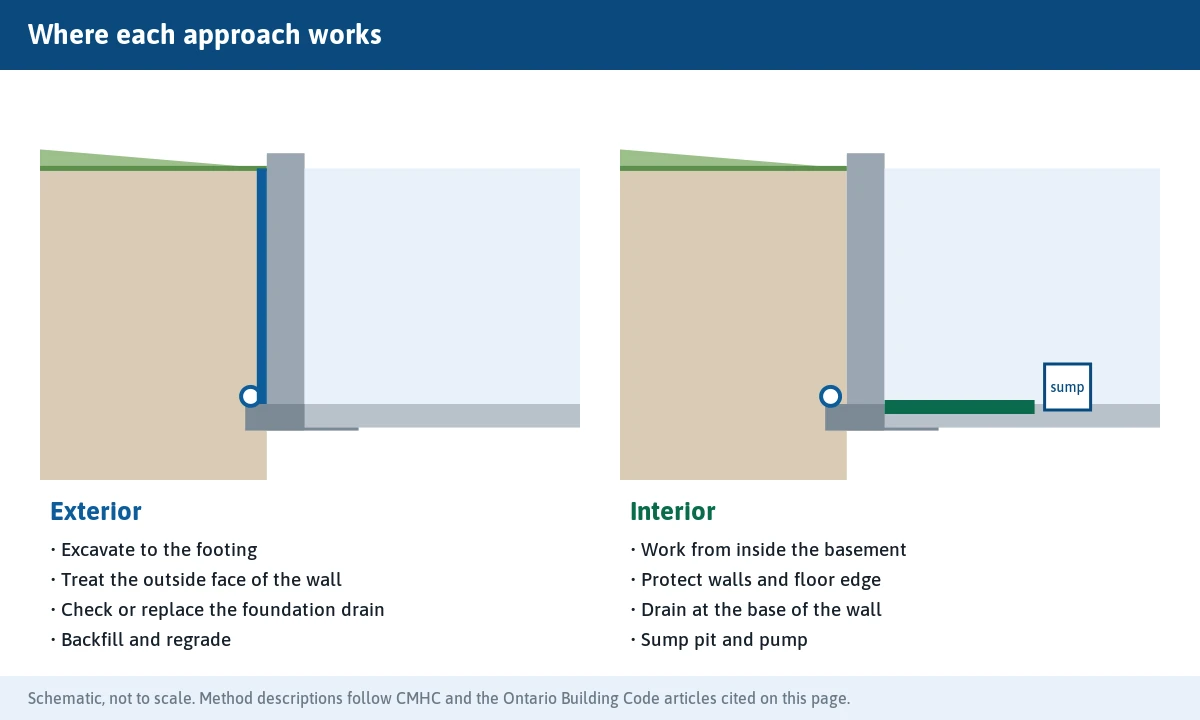
Quick answer Interior vs exterior waterproofing comes down to where the water is stopped. Exterior work treats the outside face of the wall after excavation. Interior work drains water inside, usually to a sump pump. The Intact Centre’s published rates are $100 to $300 per linear foot (exterior) and $100 to $200 (interior), but the cause should decide.[1]
On this page: What is the difference between interior and exterior waterproofing? · Side-by-side comparison · What the Ontario Building Code adds · How to decide between interior vs exterior waterproofing · What the government sources say about the two approaches · Cost: a worked comparison using only published rates · What are the common mistakes? · Questions that settle the choice · Using both · Frequently asked questions · Sources
What is the difference between interior and exterior waterproofing?
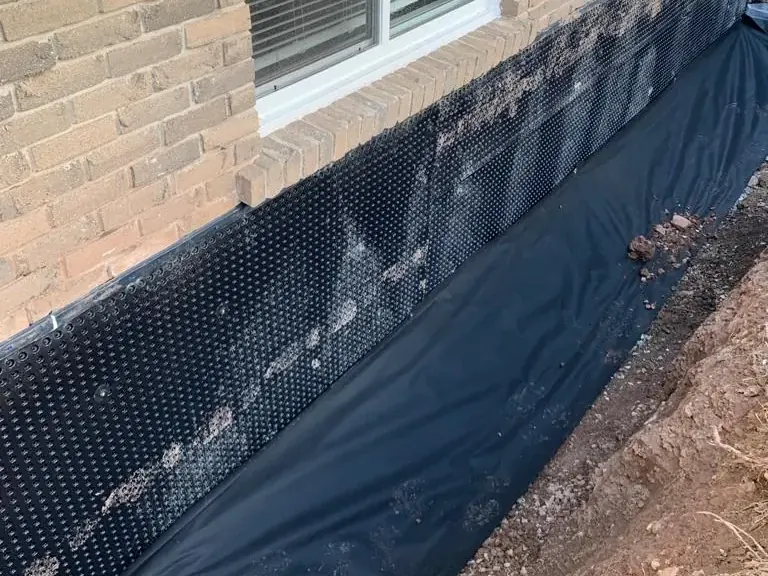
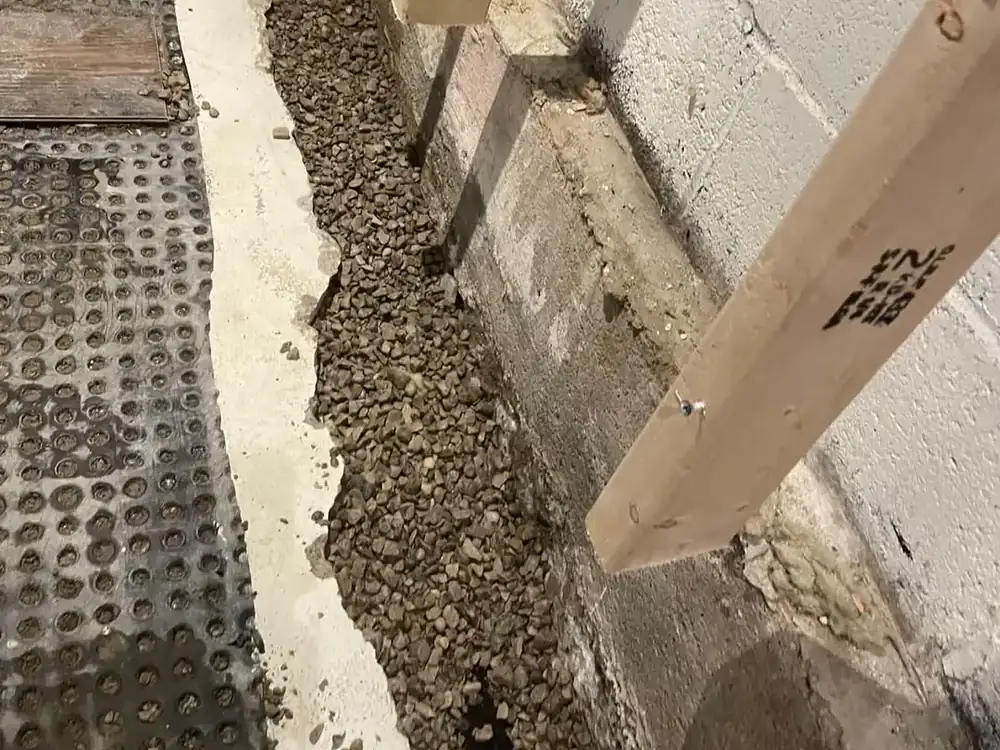
The two approaches answer different questions. Exterior work asks, “Can we stop the water at the outside of the wall?” Interior work asks, “Can we collect the water that gets in and send it out of the house?” Both can be right, and some homes use parts of each. Our guides explain each in detail: exterior waterproofing and waterproofing from the inside.
Before choosing, confirm the cause. CMHC lists water leaking through cracks in walls or floors, a high water table, exterior grading that slopes toward the house, a sump pump that is not operating properly, blocked footing drains, leaky plumbing and condensation among the causes of basement moisture.[2] Several of those are cheaper to fix than either approach, so start with why a basement leaks.
Side-by-side comparison
| Exterior | Interior | |
|---|---|---|
| Where it works | The outside face of the foundation wall, down to the footing | The inside of the basement: floor edge, walls and sump pit |
| How CMHC describes it | “Excavate and repair/replace exterior moisture barrier system” is listed among practical solutions for basement leaks[2] | Related interior steps CMHC lists include fixing cracks and leaks, repairing the sump pump and having footing drains inspected and improved[2] |
| Published price per linear foot (Intact Centre, 2024) | Exterior dampproofing $100 to $300; $5,000 minimum when drainage is installed with it[1] | Interior dampproofing $100 to $200[1] |
| Related published items | Closed-circuit camera inspection of foundation drains $325 to $700; excavate and repair a crack over ¼ inch $1,000 to $2,000 and up[1] | Sump pump replacement $350 to $700; submersible pump and well $1,500 and up; backup battery $600 to $2,000[1] |
| Ontario Building Code articles that apply | Required dampproofing (9.13.2.1), materials (9.13.2.2), preparation and application (9.13.2.3, 9.13.2.4), waterproofing where hydrostatic pressure occurs (9.13.3.1), foundation wall drainage (9.14.2.1)[3][4][5] | Interior finishes (9.13.2.5), floors-on-ground (9.13.2.6), foundation drainage (9.14.2.1), drain disposal (9.14.5.1) and sump pits (9.14.5.2)[6][7][8][9] |
| What it does not address | Condensation, indoor humidity and a failed pump. CMHC lists these as separate causes[2] | Grading, downspouts and the outside face of the wall. Toronto advises grading that slopes away and downspouts that discharge away from the foundation[10] |
| Ongoing items | Drainage and grading to be kept clear[10] | Pump with an estimated 2 to 7 year life for a replacement; backup power is advised[1][10] |
The Intact Centre list is not a quotation, does not state a currency and does not itemize labour or materials, so treat these as orientation, not prices.[1]
What the Ontario Building Code adds
The code draws a line between dampproofing and waterproofing. Dampproofing is required on the exterior surface of below-ground foundation walls where the outside ground is higher than the ground inside, but is not required where the exterior surfaces are waterproofed.[3]
Waterproofing is required where hydrostatic pressure occurs, to prevent water getting into building assemblies and interior spaces.[4] See the glossary entries on dampproofing and hydrostatic pressure.
These are construction requirements. They tell you what a properly built foundation includes.
They do not say which repair method to prefer, and we have not found a code article that does. Ask your building department what applies to repair work, and read our permits guide.
How to decide between interior vs exterior waterproofing
Health Canada lists efflorescence, a white powdery salt deposit on walls or masonry, among the signs of moisture to look for.[11]
No source we have read gives a formula. This table lines up common situations with the fixes that CMHC, Toronto and the Intact Centre list. A qualified professional should confirm the diagnosis.
| What you see | Sources point to | Guide |
|---|---|---|
| Water after rain near a downspout, patio or garden bed | Fix grading and downspouts first. Toronto advises sloping away from the foundation and discharging ideally two metres from it[10][2] | Basement waterproofing |
| A single crack that leaks | Crack repair. The Intact Centre lists injection and excavate-and-repair prices by crack size[1] | Foundation crack repair |
| Damp corners of the floor, or a pump that runs constantly | Have the footing drains inspected and the sump system checked. CMHC and Toronto both point to drains and sump pumps[2][10] | Sump pumps |
| Water through the wall in several places, or repeated seepage | CMHC lists excavating and repairing or replacing the exterior moisture barrier among its solutions[2] | Exterior waterproofing guide, linked above |
| Seepage at the floor edge or water you can manage with drainage | Interior drainage and a sump pit are the interior steps that CMHC, Toronto and the code describe[2][10][9] | Interior waterproofing guide, linked above |
| Damp walls only in summer, or condensation on cold pipes | Humidity and ventilation. CMHC lists high summer humidity, unvented dryers and missing exhaust fans as causes[2] | Condensation on basement walls |
| Water backing up through a floor drain | Plumbing protection such as a backwater valve. Toronto subsidizes backwater valves and says a licensed plumber should install them[10][12] | Cost centre |
Judging between exterior and interior for the “through the wall” and “at the floor edge” situations needs a site visit. Two contractors can give different answers for the same home. That is normal, and it is a reason to get at least three written estimates.[13]
What the government sources say about the two approaches
Two public sources speak to the comparison directly. Canada.ca says weeping tile can be installed inside the home, under the floor, but that managing water outside the home is most effective and may provide longer-term solutions.[14] NRC says the causes of basement moisture problems are mainly external, and describes two ways to protect a below-grade wall: a drainage membrane or exterior insulation, or free-draining granular backfill plus dampproofing.[15]
Neither source tells you which one your house needs. That depends on the cause. If the water arrives through a wall because of grading, gutters or a blocked footing drain, fix those first.
If the footing drain is failing and the wall is exposed anyway, exterior work can address several things at once. If a finished basement, a deck, a tight lot or a neighbour’s wall makes digging impractical, interior drainage is the alternative to price. Either way, ask each contractor for the cause in writing.
Cost: a worked comparison using only published rates
A footing 30 feet by 30 feet has 120 linear feet of foundation wall. Applying the Intact Centre’s per-foot rates gives:[1]
- Exterior dampproofing: $12,000 to $36,000 for the dampproofing item.
- Interior dampproofing: $12,000 to $24,000 for the dampproofing item.
The list also shows a $5,000 minimum for exterior dampproofing with foundation drainage and a $10,000 and up figure for dampproofing with perimeter drainage tiles, without saying which of the two methods that second item describes.[1] The totals above exclude drainage, a sump pump, permits and finishes, so they are not job prices. Our basement waterproofing cost guide explains the limits of these numbers and the Toronto and Hamilton subsidies.
What are the common mistakes?
- Choosing before diagnosing. If the cause is grading, a failed pump or condensation, neither full approach will fix it.[2]
- Treating the mould but not the water. Health Canada says mould will return unless the moisture problem is solved.[11] The EPA adds that you should not paint or caulk over mouldy surfaces.[16]
- Comparing quotes on price alone. Scope differs. Ask each contractor to itemize and use our contractor guide to compare.
- Skipping the contract. Ontario requires a written contract for home renovation work over $50, advises keeping deposits to no more than 10 per cent and says the final price cannot be more than 10 per cent over the estimate unless you sign a change.[13]
- Forgetting the permit. Toronto requires a building permit for a backwater valve, and the Intact Centre advises securing required permits before beginning.[12][1]
Questions that settle the choice
Put these to every contractor and write down the answers. Differences between quotes usually show up here.
- What did you find? Ask for the cause in plain words: a crack, drainage, grading, a pump, humidity. If a contractor cannot say, the method is a guess.
- What would you do first, and what does it cost? Cheaper steps such as grading, downspouts and pump repair are on the lists from CMHC and the City of Toronto.[2][10]
- What will you open up, inside or outside? Exterior work means excavation along the wall. Interior work means working at the floor and wall surfaces. Ask what is restored afterward, and what is not.
- Where does the water go? The code requires foundation drains to discharge to a sewer, a drainage ditch or a dry well.[8]
- How will you check that it worked? Ask what they will measure, when, and what happens if water returns.
- What is in writing? Scope, products, permits, warranty, schedule and payment, as listed in Ontario’s contract guidance.[13]
Using both
Some situations call for parts of each approach, such as fixing grading and downspouts outside while adding a sump pump inside. CMHC’s list of solutions mixes both.[2]
For wall sheet products used inside, see dimple membrane. To compare local companies, use the company directory.
Frequently asked questions
Which is better, interior or exterior waterproofing?
It depends on the cause of the water and the building. Neither is better in every case. Exterior work treats the outside of the wall and needs excavation. Interior work manages water after it enters.[2]
Which costs less?
On the Intact Centre’s published per-foot rates, interior dampproofing is listed at $100 to $200 and exterior dampproofing at $100 to $300, with a $5,000 minimum when drainage is added to the exterior item.[1] Scope differs, so get itemized estimates.
Does the building code require one over the other?
The code requires dampproofing and, where hydrostatic pressure occurs, waterproofing, in construction. We have not found an article that requires a specific repair method for an existing basement.[3][4]
Can I just add a sump pump?
It may help if water collects in the basement and drainage leads to a pit. CMHC lists repairing the sump pump and improving footing drains among its solutions. A pump does not change grading outside.[2]
Will either fix a musty smell?
Only if moisture from outside is the cause. See the musty smell guide, and Health Canada’s advice to fix the cause before cleaning mould.[11]
How do I know the contractor’s diagnosis is right?
Ask how they found the cause, ask three contractors, and compare answers. Ontario advises written estimates from at least three contractors who have inspected the area.[13]
Are there subsidies?
Toronto and Hamilton offer subsidies for plumbing protection such as backwater valves and sump pumps. Neither lists foundation waterproofing as eligible work.[12][17]
Where should I start?
Start with grading and downspouts, then check the sump pump and drains, then compare quotes. The basement mould guide covers what to do if mould is already present.
Find a pro. Looking for companies near you? Search the Waterproofing Service directory by service and city. Find waterproofing pros
Sources
- Intact Centre on Climate Adaptation, University of Waterloo (information verified and updated by AET Group, 2024). “Estimated Cost Ranges for Completing Residential Flood Protection Projects.” https://intactcentreclimateadaptation.ca/wp-content/uploads/2024/10/Cost-Range-for-Flood-Risk-Reduction-Projects_final_2024.pdf (retrieved 2026-11-18).
- Canada Mortgage and Housing Corporation (CMHC). “Moisture and Air: A Guide for Understanding and Fixing Interior Moisture Problems in Housing.” https://assets.cmhc-schl.gc.ca/sf/project/archive/publications/61033_w_05_08_2015.pdf (retrieved 2026-11-18).
- Ontario Building Code text as reproduced by CodeIndex. “Ontario Building Code 2024 (O. Reg. 163/24), Article 9.13.2.1 Required Dampproofing.” https://codeindex.ca/article/9.13.2.1 (retrieved 2026-11-18).
- Ontario Building Code text as reproduced by CodeIndex. “Ontario Building Code 2024 (O. Reg. 163/24), Article 9.13.3.1 Required Waterproofing.” https://codeindex.ca/article/9.13.3.1 (retrieved 2026-11-18).
- Ontario Building Code text as reproduced by CodeIndex. “Ontario Building Code 2024 (O. Reg. 163/24), Article 9.14.2.1 Foundation Wall Drainage.” https://codeindex.ca/article/9.14.2.1 (retrieved 2026-11-18).
- Ontario Building Code text as reproduced by CodeIndex. “Ontario Building Code 2024 (O. Reg. 163/24), Article 9.13.2.5 Moisture Protection for Interior Finishes.” https://codeindex.ca/article/9.13.2.5 (retrieved 2026-11-18).
- Ontario Building Code text as reproduced by CodeIndex. “Ontario Building Code 2024 (O. Reg. 163/24), Article 9.13.2.6 Dampproofing of Floors-on-Ground.” https://codeindex.ca/article/9.13.2.6 (retrieved 2026-11-18).
- Ontario Building Code text as reproduced by CodeIndex. “Ontario Building Code 2024 (O. Reg. 163/24), Article 9.14.5.1 Drainage Disposal.” https://codeindex.ca/article/9.14.5.1 (retrieved 2026-11-18).
- Ontario Building Code text as reproduced by CodeIndex. “Ontario Building Code 2024 (O. Reg. 163/24), Article 9.14.5.2 Sump Pits.” https://codeindex.ca/article/9.14.5.2 (retrieved 2026-11-18).
- City of Toronto (page dated April 17, 2026). “How to Prevent Basement Flooding.” https://www.toronto.ca/services-payments/water-environment/managing-rain-melted-snow/basement-flooding/how-to-prevent-basement-flooding/ (retrieved 2026-11-18).
- Health Canada (Canada.ca), published January 2023. “Guide to addressing moisture and mould indoors.” https://www.canada.ca/en/health-canada/services/publications/healthy-living/addressing-moisture-mould-your-home.html (retrieved 2026-11-18).
- City of Toronto. “Basement Flooding Protection Subsidy Program.” https://www.toronto.ca/services-payments/water-environment/managing-rain-melted-snow/basement-flooding/basement-flooding-protection-subsidy-program/ (retrieved 2026-11-18).
- Government of Ontario. “Your rights when starting home renovations or repairs.” https://www.ontario.ca/page/your-rights-when-starting-home-renovations-or-repairs (retrieved 2026-11-18).
- Government of Canada (Canada.ca, flood risk guidance). “French drains, trench drains and weeping tiles.” https://www.canada.ca/en/services/policing/emergencies/preparedness/get-prepared/hazards-emergencies/floods/flood-risk/prevent-flood-damage/french-drains-trench-drains-and-weeping-tiles.html (retrieved 2026-11-18).
- National Research Council Canada (M.C. Swinton and T.J. Kesik, 2008). “Site Grading and Drainage to Achieve High-Performance Basements (Construction Technology Update No. 69).” https://nrc-publications.canada.ca/eng/view/ft/?id=227c971d-b180-431a-9b9d-18ef18146a39 (retrieved 2026-11-18).
- U.S. Environmental Protection Agency. “A Brief Guide to Mold, Moisture and Your Home.” https://www.epa.gov/mold/brief-guide-mold-moisture-and-your-home (retrieved 2026-11-18).
- City of Hamilton (page dated September 3, 2026). “Protective Plumbing Program.” https://www.hamilton.ca/home-neighbourhood/home-property/basement-flooding/protective-plumbing-program (retrieved 2026-11-18).